Feature-News
Finland: World’s Happiest Country; A Statistical Truth, or a Partial Story?
Finland: World’s Happiest Country; A Statistical Truth, or a Partial Story?
By Staff Writer
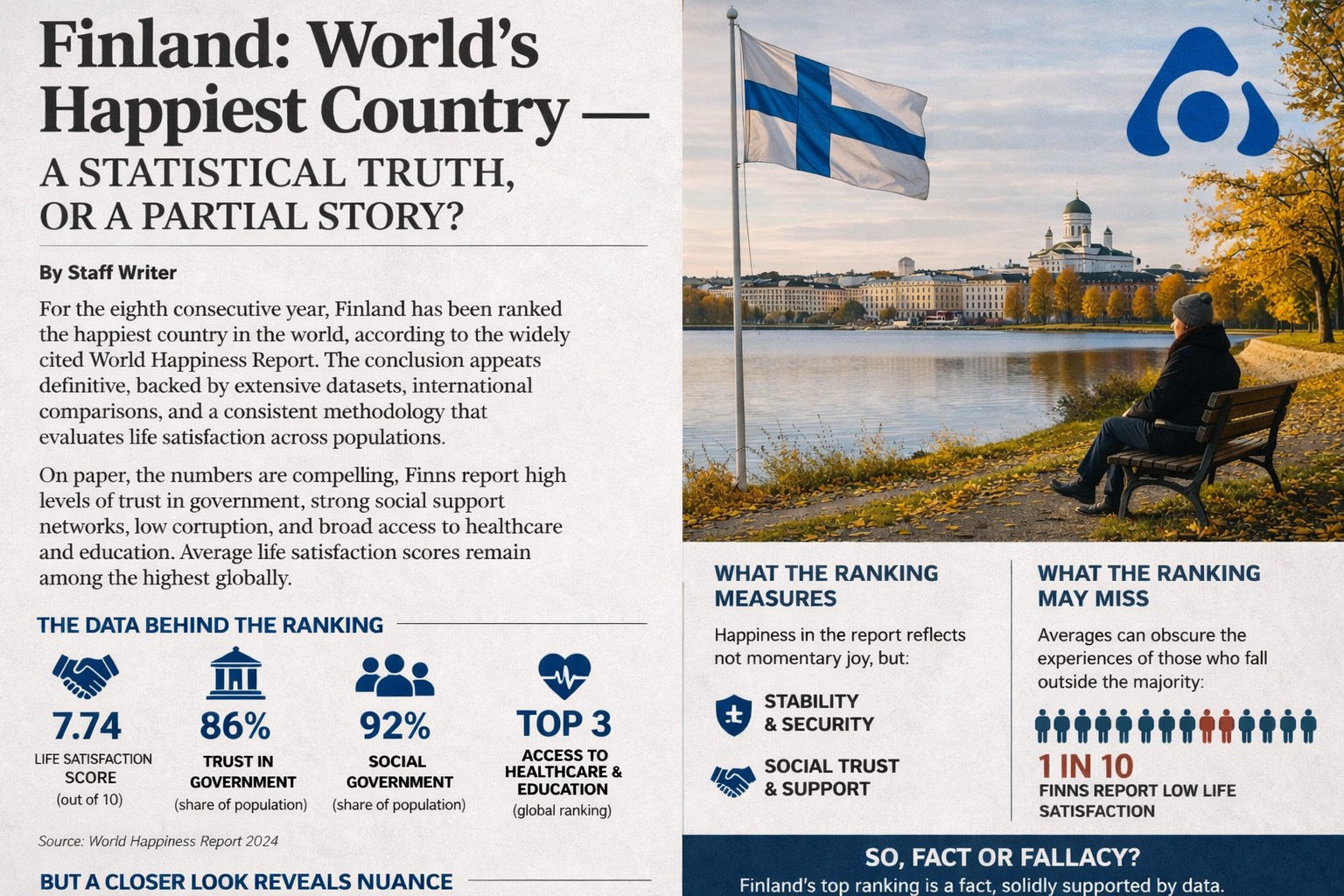
For the eighth consecutive year, Finland has been ranked the happiest country in the world, according to the widely cited World Happiness Report. The conclusion appears definitive, backed by extensive datasets, international comparisons, and a consistent methodology that evaluates life satisfaction across populations.
On paper, the numbers are compelling.
Finns report high levels of trust in government, strong social support networks, low corruption, and broad access to healthcare and education. Average life satisfaction scores remain among the highest globally, typically hovering near the upper end of the scale. Income inequality is relatively low, and citizens consistently report a strong sense of personal freedom.
From a data perspective, Finland’s position at the top is not accidental—it is statistically robust.
Yet beneath the averages lies a quieter, more complex narrative.
Happiness rankings rely heavily on mean scores, which compress millions of individual experiences into a single figure. While Finland’s national average remains high, averages by nature conceal variation. A closer look at regional and demographic data suggests that not all experiences align neatly with the national story.
Mental health indicators, for instance, reveal a steady demand for psychological support services. Certain rural areas face population decline and reduced access to care. Youth unemployment, while lower than in many countries, still presents localized challenges. These factors do not overturn Finland’s ranking—but they complicate it.
Experts note that “happiness” in such reports is not a direct measure of daily joy or emotional expression. Rather, it reflects a broader evaluation of life conditions: stability, security, and institutional trust. In that sense, Finland excels.
But this raises an important question: does a high national score equate to universal well-being?
Statistically, the answer is no.
Even in top-ranked countries, a small percentage of respondents report low life satisfaction. In large populations, these “outliers” represent thousands of individuals whose experiences diverge from the national average. Their voices, while present in the data, carry little weight in determining rankings.
This does not invalidate the findings—it contextualizes them.
Finland may indeed offer one of the most stable and supportive environments for human well-being currently measured. The data supports that conclusion. However, interpreting the ranking as a complete picture of lived experience risks oversimplification.
Happiness, as captured in global reports, is a reliable metric of societal conditions. It is less precise as a measure of individual reality.
So, is Finland’s ranking a fact or a fallacy?
It is, unequivocally, a fact—grounded in rigorous data.
But like all statistics, it is also a summary.
And summaries, however accurate, never tell the whole story.