Feature-News
"Will the US-Israel Conflict with Iran Spell the End of the Petrodollar System? " The War That Shook the Petrodollar – And the Odd Couple (Yuan & Euro) Waiting in the Wings
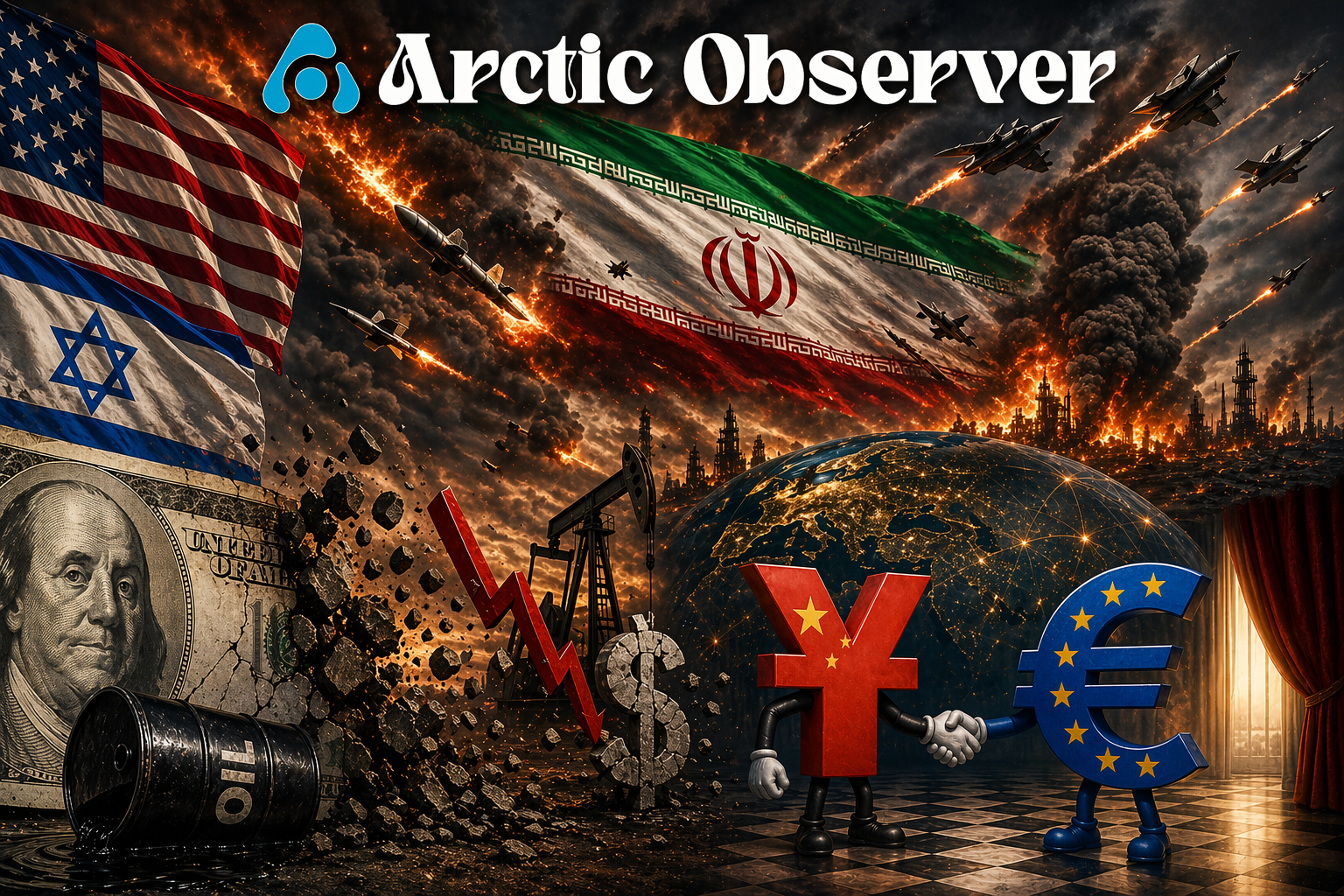
A feature story about oil, money, and the quiet end of an era
Have you ever felt that awful realisation when you find out something you thought would last forever really was just a habit? That is how I feel about the current petrodollar system.
For the past half-century, the global economy has been based upon a very straightforward arrangement: The major oil producers in the Gulf, including Saudi Arabia, agreed to sell all of their crude oil only in U.S. dollars. In return, the United States agreed to protect these countries. This meant that any country that wanted oil needed to hold U.S. dollars to be able to pay for it. This meant that U.S. dollars were widely available throughout the world. As such, the United States was able to borrow money at very low interest rates, run large budget deficits and essentially dictate the rules of global finance.
But habits can change, and wars can accelerate those changes.
In late February 2026, the U.S. and Israel launched a joint military attack on Iran. Within weeks of the attack, the Strait of Hormuz, through which approximately 20% of the world's oil flows, became a battleground for financial institutions. According to reports, Iranian military units required oil tankers to pay for passage through the Strait using either Chinese yuan or cryptocurrency; therefore, shipping in U.S. dollars was subject to substantially increased risk and delay.
The erosion that had been happening gradually suddenly shifted to a potential rupture. Is this war going to be the end of the petrodollar? If the dollar falters, who will take its place? Let's examine the current situation and address how the Chinese yuan and the euro are two completely different competitors in the race to replace the dollar.
The Original Magic of the Petrodollar – And Why It Is Losing Its Luster
In 1974, the genius design of the agreement was basic and very simple; the United States was going to protect Saudi Arabia’s oil fields. In return, Saudi Arabia would:
• Price all their oil in US dollars,
• Invest much of the oil proceeds into US Treasury bonds.
The result was the formation of a closed-loop system; all countries needed US dollars to buy oil, therefore, everyone began stockpiling US dollars. Those funds ultimately found their way back to the US as loans, thus allowing interest rates to remain low in the United States. The United States' military protected the shipment of oil across various maritime routes. Everyone benefited from this closed-loop system.
However, over the last 10 years, this closed-loop system has begun to develop fault lines.
Initially, there was a time when the United States required oil from the Persian Gulf, but that situation is no longer valid due to the shale revolution, making the U.S.A. a net exporter of oil. Conversely, the Chinese have become the world’s largest crude importer, taking about four times more barrels of Saudi-produced crude oil than the United States does. Therefore, why would Saudi Arabia continue to bill everything in dollars to keep Washington happy?
Secondly, the security guarantee that Saudi Arabia has had from the United States has begun to show signs of deterioration. The air defence system that would be protecting the energy infrastructure of its allies in the Gulf Region was ineffective during Iran’s War against Iraq in early 2026. Iran has demonstrated its ability to selectively choke off the Strait of Hormuz, making it difficult for Gulf countries with close ties to the United States to be defended from an attack by Iran. How can they expect the party protection to be much cheaper than another provider of protection, once you have found a more reliable source of service?
The Impact of the War on the Petrodollar: The Petroyuan's Birth
Before the war, there were indications that the petrodollar may have been losing ground. The dollar was no longer as dominant a currency as it had been. For instance, by December 2025, it had fallen to the lowest level of currency reserves in the world (56.77%), as compared to 72% in 2001. Henceforth, the war has caused this trend to accelerate significantly.
Financial data indicated that, as of March 2026, 41% of Middle Eastern crude oil trade was settled in yuan—a figure that had been essentially zero only a few years prior. All of Iran's oil exports are currently being sold to China in yuan, and Saudi Aramco now uses yuan for 45% of its exports to China.
As a result of the war, dollars now account for less than half of the total amount of oil traded in the Middle East (approximately 52%) as of early 2026 (down from over 90% at the start of 2018).
According to an analyst at Deutsche Bank, "This conflict could create the perfect storm for the petrodollar and the establishment of the petroyuan."
However, before declaring the dollar dead, it is also important to acknowledge the larger picture. The dollar is still the predominant currency for global payments, representing approximately 50.49% of all SWIFT transactions in December 2025. The euro is a significant distance behind at 21.9%, and the yuan is still hardly worth mentioning at 2.74%.
So, the petrodollar isn’t dead. It’s just… wounded. And that wound has opened the door for two very different challengers.
A Comparison Between The Chinese Yuan and The Euro As Possible Reserve Currencies
If the petrodollar system collapses, there will not be a simple switch to one new currency; rather, there will be several competing designs for a new global monetary system, as the world breaks into various zones or regional monetary unions. Here is a look at two major contenders for reserve currencies.
The yuan (CNY) is the 'shopper's card' for China.
The CNY can be viewed as a 'loyalty card' for the world's largest consumer of raw materials. China is the biggest buyer of oil, copper, iron ore, and rare earth elements and has developed a domestic payments system known as the Cross Border Interbank Payment System (CIPS), which has emerged as a competitor to the Society for Worldwide Interbank Financial Transfers (SWIFT). In 2025, CIPS will have processed 980 trillion CNY in transactions; an increase of 43% since 2024. From 2023 to 2024, 70% of all CNY payments were made directly through CIPS instead of being processed by SWIFT; as a result, the official SWIFT figures for the CNY (shown as approximately 2.7% of global payment activity) significantly understate the actual activity in CNY.
The yuan's strength lies in its use for trade-related financing, such as providing loans and letters of credit that are critical to keeping global supply chains running smoothly. By the year 2025, the amount of trade-related financing provided by the yuan was predicted to be about eight percent of total trade-related financing worldwide, which is second behind only the US dollar and demonstrates an ongoing real-world example of commerce.
However, there is one major issue: the yuan is not a freely convertible currency because China restricts capital outflows from the country, so you cannot readily take your yuan and convert it into whatever you want. This helps to explain why the yuan's share of global reserves has been stuck at around two-point one percent and has barely changed over the last ten years.
Therefore, while the yuan works great for purchasing goods from China or selling crude oil to China, it does not yet work well as a currency used as a store of value for central banks.
🇪🇺 Euro—A Stable, Somewhat Unexciting Option
Compared to the Yuan, the Euro is unlike any other money. Yuan only has a single individual (the Chinese government) behind it for backing purposes, whereas the Euro has more than just one country that makes up an entire continent, the Eurozone, and their combined total economy is worth $15 trillion; they also have some of the largest financial markets globally; in addition, they also have their own independent central bank that has been operating for the last 25 years.
The Euro represents about 20% of all international reserves held today, and approximately 40% of all international trade invoices are written in Euros, thus establishing itself as the world’s clear 2nd trading currency.
One of Euro’s long-term weaknesses is its fragmentation. An example of this would be the fact that there is not a singular “Eurobond” similar to that of U.S. Treasuries, wherein the E.U. can issue 1 common bond that is absolutely safe (Eurobond) and every country in the E.U. that issues a bond does so individually, e.g., Germany’s issues are viewed as very safe, whereas Italy’s are not. Therefore, the absence of a single safe asset creates uncertainty for those finding reserves to maintain.
Furthermore, Europe’s economy has been growing very slowly and has struggled. In 2025, Eurozone growth was only 0.8%, and this conflict with Iran has increased energy costs, thus adversely affecting the European economy.
Lastly, despite this adverse impact from this conflict with Iran, the conflict is uniting European leaders for the long term; as an example, Christine Lagarde has called for a time for the creation of a Global Euro Moment, as he has expressed that Europe must have its own unique financial independence, especially if the U.S. is going to continue to use the dollar as a weapon. This is a significant opportunity and presents a positive development moving forward.
Let’s put them side by side (human‑friendly version)
| What we’re measuring | Yuan (RMB) | Euro |
| Share of global reserves | ~2.1% | ~20% |
| Share of global payments (SWIFT) | ~2.7% | ~21.9% |
| Oil trade settled in this currency (Middle East, March 2026) | 41% | Minimal direct share |
| Biggest strength | China’s buying power; CIPS network | Deep capital markets; established trust |
| Biggest weakness | Not freely convertible; capital controls | Fiscal fragmentation; low growth |
| Geopolitical tailwind | Dollar weaponisation fears | EU strategic autonomy push |
| Realistic best‑case role | Primary trade currency for Asia & commodities | Primary reserve currency for Europe & allies |
Will the Iran War bring about the end of the Petrodollar?
The answer is: Not in one single day. Even after the war, the U.S. dollar will remain the most favoured currency around the world. During times of uncertainty and conflict, such as the 2026 military conflict, investors run to the U.S. dollar. The dollar index was able to regain 100 in March 2026. The Dollar functions as a haven and, historically, has provided great security for many global investors.
However, the Iran War did something to destroy the long term confidence in the Petrodollar as a viable risk-free investment. Gulf oil exporters have come to see that the risk of an interruption in shipping through the Strait of Hormuz (Iran) increases the likelihood that U.S. dollar-denominated shipped goods will experience a "risk premium" and cause them to consider other currencies (Yuan or Euro) or physical gold instead.
The shift in willingness to deal in alternative currencies will grow over time and will change the Petrodollar system of trade into something completely different through repeated occurrences in multiple countries. The transformation will occur slowly and continuously, versus an instantaneous catastrophic event.
What can we expect in the future...
Do not expect a new petrodollar to be created - there will not be a new PETROYUAN or PETROEURO replacing the PETRODOLLAR. Rather than a new PETRODOLLAR, you can expect an ongoing process where multiple different currencies are utilised for oil transactions.
China and Russia are going to continue to transact in YUAN; they do already.
Europe will continue to try to push ENERGY TRADE in the EUROS.
GULF STATES will discreetly DIVERSIFY into different currencies: YUAN AND EUROS WILL BE SOME OF THEM, DOLLARS POSSIBLE AS WELL AS DIGITAL CURRENCY AS WELL.
The DOLLAR MAY BE THE LARGEST SINGLE CURRENCY, HOWEVER; IT WILL CONTINUE TO LOSE SHARE, AND I PREDICT BY THE YEAR 2030, IT WILL BE AT OR BELOW 50% OF THE WORLD'S RESERVES.
I recently spoke to an analyst who said (OFF THE RECORD), "The PETRODOLLAR isn't going to die dramatically. The death of the petrodollar will take place by bleeding out through MANY SMALL CUTS, AND THE IRANIAN WAR WAS ONE OF THE SO-CALLED DEEP CUTS SO FAR."
To sum up:
Although the conflict in Israel and Iran has changed the way countries view the Petrodollar, it hasn’t destroyed it yet, but it does have cracks starting to form throughout its foundation. For the first time, multiple tankers, transporting oil via a major trade choke point, can now pay in Chinese currency (Yuan) vs U.S. dollar (USD). This is a big deal.
The Yuan is growing at a healthy pace in terms of oil trading and other types of trade, but because China has all its capital controls, there is no way that the Yuan will ever be classified as a reserve currency like the USD. Europe, while still being a good alternative, is suffering from individual member state economics and the inability to agree on a common monetary policy, which will result in moderate growth but keep it off the top of the reserve currency list.
Neither will the currency ultimately win”, rather than that a new status quo will form amongst fiat currencies whereby the USD will remain "first of equals" and will not be an absolute or definitive king of currencies. Consequently, the change of status for the reserve currency will eventually change how all countries view reserves and currency.
Finally, the next time that you hear the statement "the Petrodollar is dead," please smile and respond with "not dead, just working on its retirement."
(Sources for the numbers in this story: IMF Q4 2025 data, SWIFT December 2025, Deutsche Bank research notes (March 2026), ECB annual report 2025, CIPS transaction data 2025, and multiple oil‑trade tracking platforms covering March 2026.)