Feature-News
Learning to Fix the Door: Europe After America Steps Back
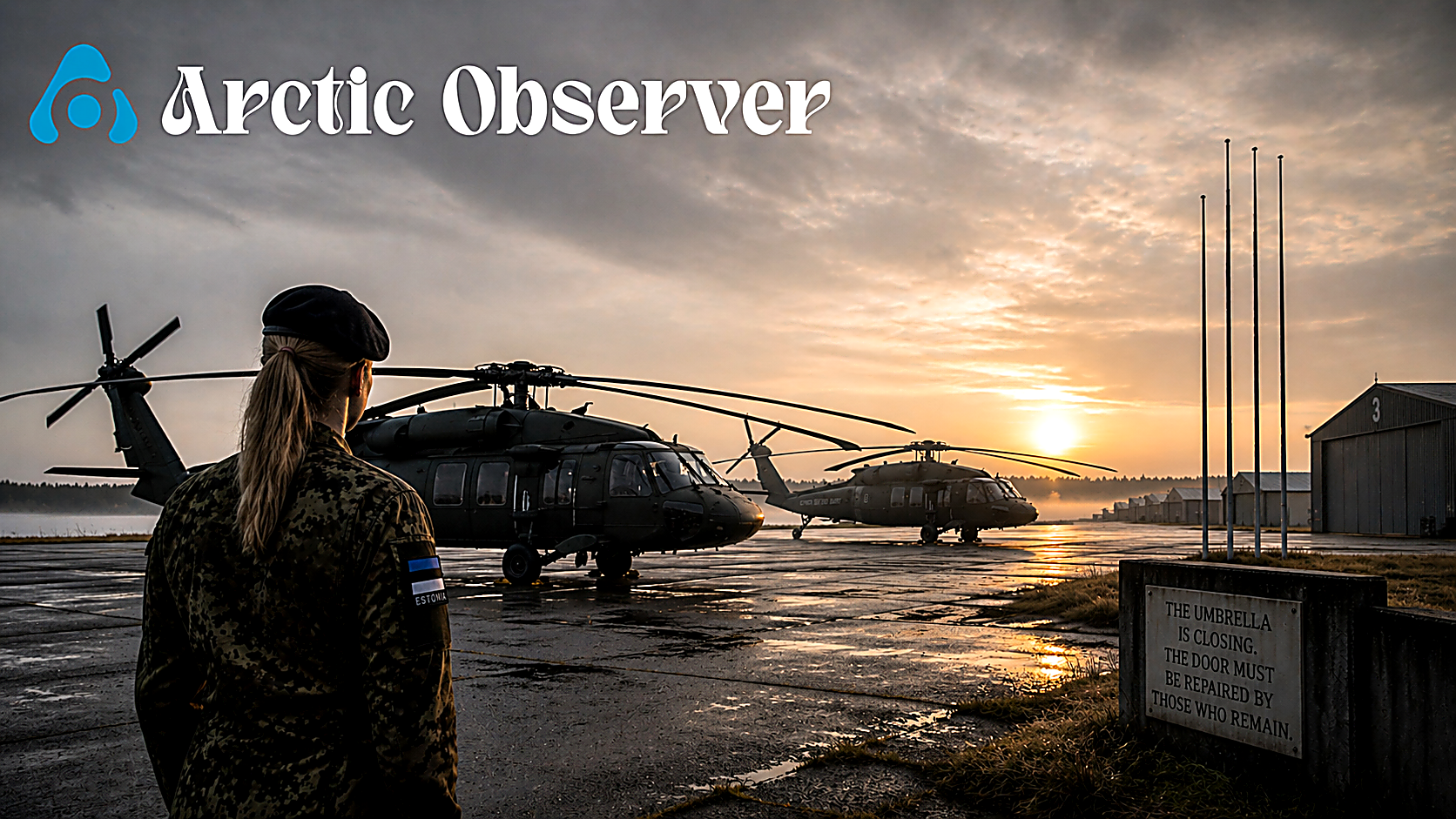
Summer 2026 – somewhere in eastern Estonia
Captain Liisa Tamm was still standing at her field radio, looking out at a pair of U.S. Army Black Hawk helicopters that were idling on the ramp of the Ämari Air Base as the morning fog was starting to clear. Liisa's grandmother, who remained sharp at age 92, had always said the U.S. would come like spring (late, but it would come). Liisa and her generation had believed this was true until now.
Her commanding officer, a British major, approached her with a tablet computer that displayed a Pentagon briefing. He stated, "They are moving the 173rd Airborne back to Italy. This is only the beginning."
Liisa continued to stare at the Black Hawks. They had been a promise, now they were rapidly fading from view.
Many view the current situation as Unsettling, just as many people view the current state of NATO, if viewed as a Totality (NATO) of the NATO alliance has changed. If there ever existed one, for many throughout Europe from Warsaw to Lisbon, a sense of quiet is beginning to settle down across the continent due to NATO, which existed under the belief that a NATO member state would receive full military support from the United States in the event of an attack against it.
A Divorce Disguised as a Discussion: The Reality of NATO
NATO appears still to be functioning on the surface: embassies are hosting receptions; the North Atlantic Council is holding its meetings. However, if you walk through the halls of the German Ministry of Defence, you will hear a much different story from the people occupying those rooms. Recently, over coffee, I heard one German official express the sentiments of many who believe that their country used to have partners that did most of the work. Now they look around and see they are in the hallway by themselves, and the number of bags (weight) they are each carrying is becoming overwhelming.
This “trigger” for the split between partners in NATO wasn’t an individual explosive incident; it has been a slow but steady leaking of trust over time. For example, when Washington suggested to NATO members to take charge of their own defense (and have their own military capability), when US troop rotations in Germany were changed to short-term deployments further West, and when nuclear-sharing arrangements of the last 70 years provided some level of comfort to Europe's capitals, now that those arrangements are being used as fodder (budget memos) in the White House — all these examples provided a decisive message of the end of NATO's existence; not by a formal declaration, but instead a message of absence.
"Picture that you've depended on your big brother all your life," says Tartu-based teacher Kaia. "He is a very large, strong fellow and has always told you that he would support you; now he has decided to concentrate on his own part of town and will no longer be able or willing to help you, but, of course, he still loves you; he just has a new life, many states away." There is a brief pause before she continues to tell me, after stirring her tea, "Now you will have to learn how to fix that door yourself."
The Quiet Plan
What will happen when there is no longer someone to protect you from harm? For the past two years, military and civilian officials in Europe have been devising answers to this question. They prefer not to use the term "EU Army" because it scares people; they instead refer to their efforts as "continuity assurance." The plan is very much reality-oriented: European officers will gradually take over leadership positions held by U.S. military leaders during the Cold War; they will develop alternative lift capabilities to replace those of the U.S.; and they will determine what kind of nuclear deterrent Europe would need.
While talking with a French Colonel working on this issue over coffee near the Champs-Élysées, he drew a diagram of the above on a napkin. He stated, "We don't want to replace the United States; however, we want Russia to believe that if it crosses the Narva River again, it will be making a serious error. Therefore, we need to develop a second pillar to support our current psychological strategy."
Psychology plays just as large a role in robotics and artificial intelligence as hardware does. I was speaking to Andrzej, a Polish Border Guard posted to the area around Suwalki-Land, which is the narrow area between Belarus and Kaliningrad. Andrzej has seen a noticeable increase in the number of Russian-speaking individuals engaging in conversations over his scanners, and many more unmanned drones are conducting flights in the area. "You can sense it," said Andrzej. "You sense the change in atmosphere first before any speeches are made. There is a change in the air (atmosphere of tension) when your larger partner looks away, the smaller (less powerful) bullies will start voicing their threats."
The most difficult discussion
Out of all the gaps present, the nuclear gap is the one that connects us all as humans, as it brings into focus the prospect of having to address the unthinkable. For decades, America’s nuclear arsenal sent an unmistakable signal to every European capital: “If someone attacks you, they are attacking us”. This message kept Europe’s nights sleeping soundly. Today, however, government officials are openly discussing developing a “European deterrent framework” that will rely on the British and French nuclear arsenals for deterrence. The situation is more complicated than that.
Take, for example, the example of Hannelore, a retired nurse from Mannheim, Germany, who remembers the debates concerning the deployment of Pershing missiles in Europe during the 1980s and the many protests to oppose them. She also recalls the fear of annihilation that deployment would create. When I asked her if she would sleep as well with a French nuclear guarantee as she did when the Americans’ guarantee was in place, she smiled, but her laughter was hollow. “We had to trust the Americans because they were far away, and they had so much power,” she pointed out. “The French are our neighbours; how can Paris make its own trade to protect Berlin??? And that is not a scenario we can test until the moment it arrives.” Then, after a brief pause, she stated, “We have no other option at present.”
Her grandson, Lukas, is 22 years old and wants to enlist in the Bundeswehr, even though he has never lived in a world without the protection of America. As he explained, “My generation has to develop a deterrent strategy that has never existed before”. He says it very matter-of-factly and with no bravado. There is simply a sense of hopelessness in his tone.
The New Leaders, With or Without Desire
The flavour of change is akin to a person possessing an identity that can change by wearing different clothes. For example, Friedrich Merz in Berlin began his reevaluation from a standpoint of awareness/sight and not a personal desire for the glory associated with Europe; rather, it was an awareness of reliance on other countries for the basic needs of people living in Berlin. The pressure on Emmanuel Macron in Paris to create a strategic autonomous framework has changed from being more poetic to being a necessity for survival. Outside of being members of the European Union, the UK will again participate in the discussion on defence and security, however, only if the nuclear issue can be resolved. The Finnish president demonstrates how others feel regarding the shifts associated with a burden. He commented by saying, "The shift of burden is taking place; we must manage the shift to avoid breaking anything".
Leadership exist beyond the politicians, for example, the Rotterdam logistician with the responsibility to move tanks, but must do so without having access to American air transportation. Or the cyber expert located in Tallinn who understands that a long-term strategy will mean that Russia's first strike against the unified nations will not be the use of tanks. Or an Italian politician explaining to his voters why there is no increase in pensions, but rather there is a decrease that allows for the use of funds to purchase drones. As stated by a French diplomat, "This isn't about loving Brussels; this is about waking up."
An Altered Place
Envision a small community in Latvia (a border nation with Russia), summer twenty twenty-eight. You might see some stars-and-stripes flags flying somewhere, but far fewer years have passed. The military exercises are being conducted by a Polish General with a German Division (currently stationed nearby) on standby. An increasing number of local children are exposed to English; however, instead of the US, if they look at their atlas, there is a different main "centre of gravity". MARGITA, a young mother, is putting her daughter to sleep and checking her cell for any notifying messages. "If something were to happen, will the Americans come? I didn’t use to think much about that anymore; now I am thinking about the Finns and the Swedes and the Poles...We are trying to build a solid, new relationship; although not yet finished, it is still ‘ours’."
This is how post-Americanism is beginning to sound throughout Europe. Neither a collapse nor a drama-free victory, but lengthy periods filled with concern. There is no quick fix to rebuilding 'trust'; it takes place over time and through repetition and daily confirmation. Deployments, shared education and training programs, and joint radar hosting are the threads used to 'sew' together a new fabric; will it be 'thick' enough to be used the same as the last fabric? Only time will tell.
Eight Decades of NATO Change Than Before
In 2029, NATO will reach its 80th year as an alliance with a likely Summit in either Washington or Brussels. While they will make the expected remarks about their "enduring bond" the real discussions will occur away from the cameras, and will consist of topics such as, "What will occur when the last brigade from America departs Germany"; discussions on how many times the "Franco-British Nuclear Council" will have convened by that time (at least twelve); and discussions on how to quietly integrate "European Forces" into a structure capable of functioning in the absence of the White House's involvement.
By this time, Liisa Tamm will be a major (and actually much different from this day), will have been in a very different place within the three years, very self-reliant, somewhat nervous, yet highly mature. She will still want to be able to have the Americans there in the same old way. However, history doesn’t give you what you wish for. Rather, history gives you what you create or make.
Her grandmother, who at one time saw Soviet tank columns that passed by American diplomats with smiles on their faces, and then said, “History is a garden you water; otherwise, it dies.”
European nations are watering. Their hope is heavy; the dawn of a new type of Europe is coming and has never been owned before by any nation since the last world war.