Feature-News
The Trump is saved ! Future Peace – At the Zoo
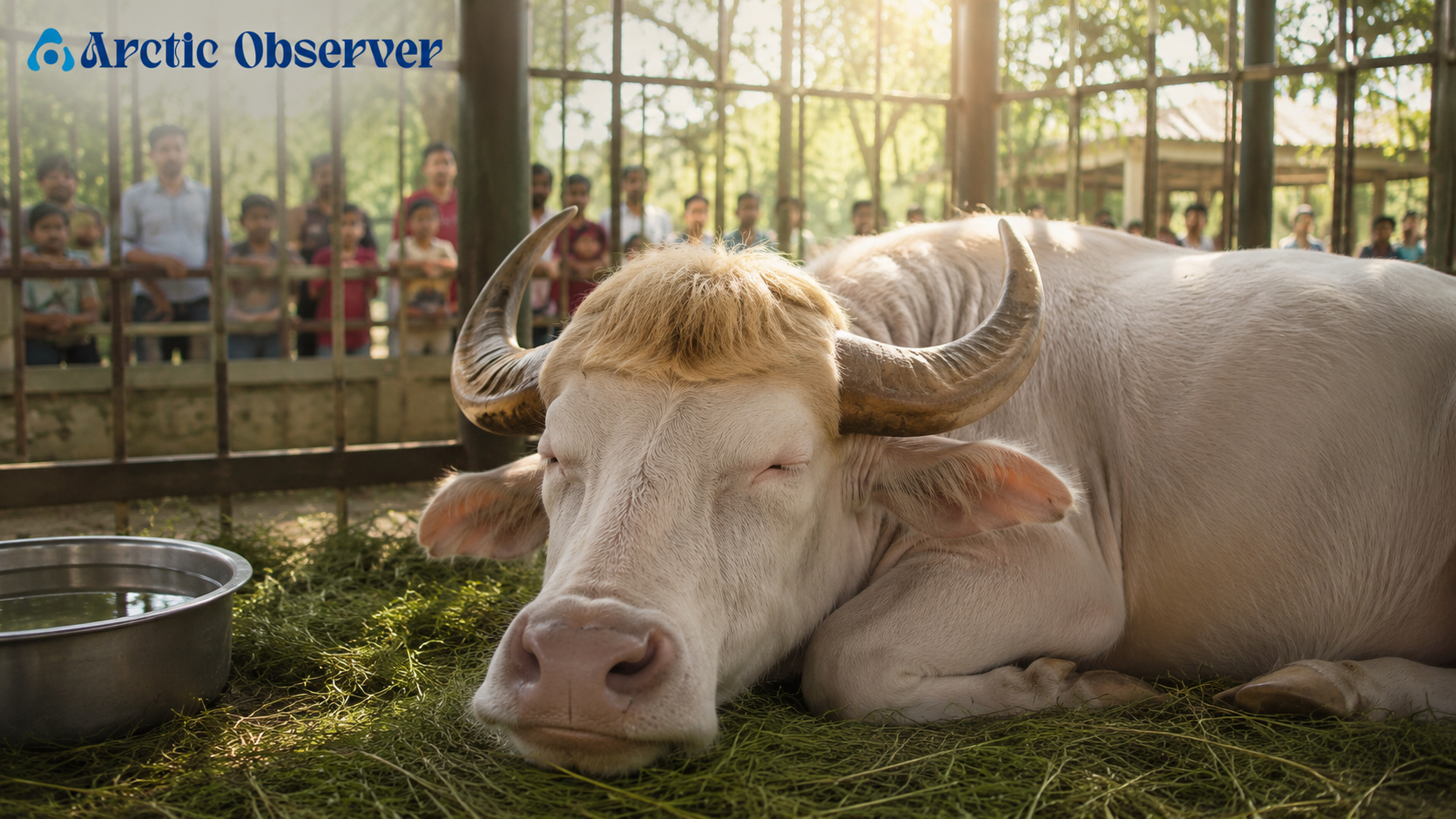
Narayanganj, Bangladesh – He doesn't know he's famous.
He doesn't know that his pale, pink-tinged skin and that ridiculous blond tuft between his horns have made him a global meme, a political cartoon come to life, and now – a living symbol of mercy.
The buffalo named "Donald Trump" knows is the warm mud of his pen, the rough but gentle hands of his owner, and the strange crowds that have been gathering for days, staring at him like he's a movie star.
And this morning, he doesn't know that he was supposed to die.
The Joke That Stuck
Zia Uddin Mridha never meant for any of this. He's a simple farmer, a man who wakes before dawn and speaks to his animals like they're his children. Three years ago, when an albino calf was born on his farm – a rare, almost mythical creature with eyes the color of a winter sky – his younger brother took one look at the fuzzy white fringe on its forehead and laughed.
"He looks like Donald Trump," the brother said.
It was just a joke between two tired farmers. But the name stuck like glue. Soon, the whole village was calling the buffalo "Trump." Then the whole district. Then, thanks to a few cellphone videos that exploded across Facebook and TikTok, the whole world.
"I never thought," Mridha says, shaking his head, "that a name from a joke would save his life."
The Sale That Felt Like a Funeral
In Bangladesh, Eid-ul-Adha is a sacred time. It's about sacrifice, yes – but also about sharing, about community, about remembering that wealth means nothing if you don't give. Every year, millions of animals are bought and offered. It is an honor for a family to raise a fine animal, and it is an honor for that animal to be chosen.
So when a buyer from Keraniganj offered a good price for the Trump buffalo, Mridha accepted. Business is business. The animal was healthy, beautiful in his own strange way, and ready.
But something felt wrong.
The night after the sale, Mridha couldn't sleep. He kept walking out to the pen, scratching the buffalo behind its ears, watching the animal blink slowly in the dark. The buffalo didn't struggle. It didn't moan. It just leaned its heavy head into Mridha's chest, like a dog asking for comfort.
"He knows something," Mridha whispered to his wife. "I swear, he knows."
The Call That Changed Everything
By morning, the news had spread. "Trump buffalo to be sacrificed!" screamed the headlines. And then the phones started ringing.
First, it was curious neighbors. Then reporters. Then activists, animal lovers, and – bizarrely – a few political fans who thought the buffalo's name somehow made it untouchable. "You can't kill Trump!" they shouted outside the farm gate. "It's bad luck!"
But Mridha had made a deal. He couldn't back out. He sat on his porch, head in his hands, feeling like a man about to lose a friend.
Then, around noon, a white government car pulled up.
The home minister himself, Salahuddin Ahmed, had heard the story. Someone in his office had shown him the video of the gentle albino buffalo, standing calm while children patted its nose. Someone else mentioned the international headlines – the BBC, CNN, Al Jazeera all running stories about "Trump the sacrificial buffalo."
And the home minister, a busy man with a million problems, did something unexpected. He paused. He thought. And he picked up the phone.
'Let Him Live'
Within hours, Keraniganj police arrived at the buyer's house. Officer Ruhul Quddus – a stern man who normally deals with thefts and disputes – found himself explaining that, yes, the government was intervening to save a buffalo because of its name. He almost laughed saying it.
"The home minister personally requested this," Officer Quddus told the confused buyer. "We will refund your money. But this animal… this animal is now a matter of public sentiment."
The buyer, to his credit, didn't argue. "I didn't know he was so loved," the man said quietly, handing back the rope. "If the government says so… let him live."
The Moment of Mercy
Back at the farm, Mridha got the news while feeding his animals. A young policeman ran up, out of breath, and said the words that made the old farmer's knees go weak.
"The buffalo is safe. No sacrifice. He's going to the national zoo."
Mridha didn't cry in front of the policeman. But later, alone in the pen, he knelt down and pressed his forehead against the buffalo's broad white skull. The animal snorted softly, warm breath on the farmer's neck.
"You're going to live in the capital now," Mridha whispered. "Big zoo. Lots of visitors. You'll be a king."
He doesn't know if the buffalo understood. But for a long moment, neither of them moved.
A New Chapter
This Eid, millions of animals will be sacrificed across Bangladesh in a tradition that is sacred and deeply meaningful. And one strange, pink-eyed, blond-tufted buffalo will be lying in fresh hay at the Dhaka National Zoo, chewing contentedly, utterly unaware that he owes his life to a joke, a viral video, and a home minister who decided that some things – even in a busy, troubled world – are worth saving.
Atiqur Rahman, the zoo's curator, says the buffalo is "very young, very calm, and already a celebrity." He'll be quarantined for two weeks, then given a permanent home. A caregiver has been assigned just to him.
"It's a kindness," Rahman says. "And sometimes, kindness is its own kind of sacrifice."
As for Zia Uddin Mridha, he's still getting used to the silence. The crowds are gone. The cameras have left. But he's kept a small rope from the buffalo's pen – just a piece of frayed nylon.
"I'll go visit him in Dhaka," he says, smiling for the first time in days. "Maybe take him some grass. Tell him I'm sorry we couldn't keep him."
He pauses, looking out at the empty pen.
"Funny," he says softly. "A buffalo named after a president. And in the end, he just wanted to live."
---
This Eid, if you happen to visit the Dhaka Zoo, look for the pale buffalo with the blond fringe. He doesn't know he's famous. But he knows a gentle touch when he feels one.