Just In
"Money Vs Reality"
Minimum Wage Mirage: Why €2,771 in Luxembourg Buys Less Than €2,343 in Germany
Eurostat data for July 2026 reveals a stark divide between Europe's highest-paid minimum wage earners and those with the most real spending power—and the gap is widening.
---
When it comes to minimum wages, the headline numbers tell one story. The reality of what those wages actually buy tells quite another.
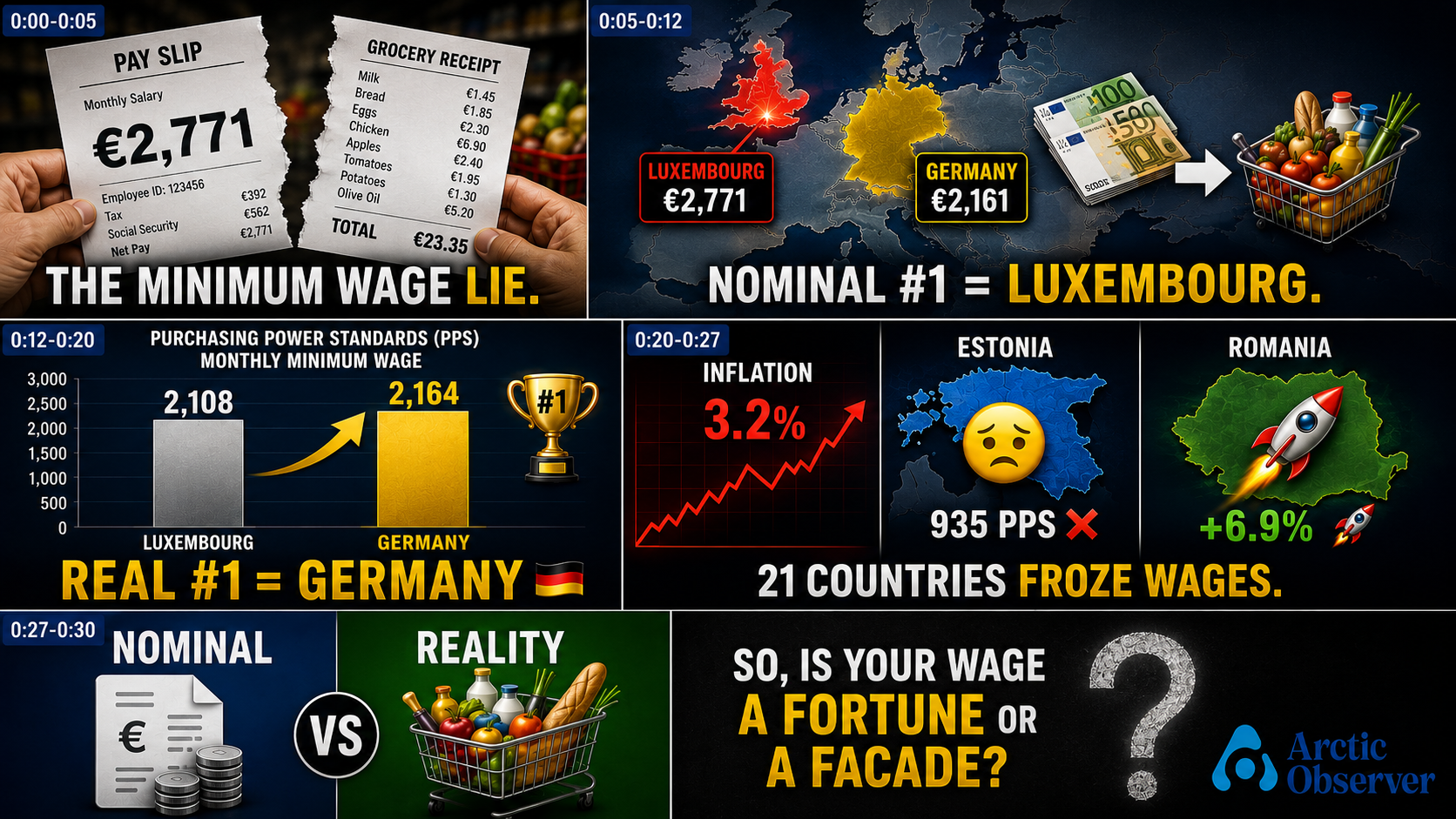
According to newly released Eurostat data for the second half of 2026, Luxembourg boasts Europe's highest gross monthly minimum wage at a nominal €2,771. Ireland follows at €2,391, Germany at €2,343, the Netherlands at €2,338, and Belgium at €2,234—the five countries where minimum wage exceeds €2,000 per month.
At the opposite end of the spectrum, Bulgaria has the EU's lowest minimum wage at just €620. When including candidate countries, Ukraine's €169 and Moldova's €313 stand as the continent's lowest figures.
But these nominal figures can be deeply misleading.
When adjusted for Purchasing Power Standards (PPS)—an artificial currency that equalizes what people can actually afford across different countries—the rankings transform dramatically.
Germany leapfrogs Luxembourg to claim the top spot with 2,164 PPS, ahead of Luxembourg's 2,108 PPS, the Netherlands' 2,023, Belgium's 1,922, and Ireland's 1,756. In other words, Germany's minimum wage workers can buy more with their €2,343 than Luxembourg's workers can with their €2,771, once the cost of living is factored in.
"PPS provides a fairer comparison through an artificial currency that captures what people can genuinely afford in each country," Eurostat explains. "In theory, one PPS can buy the same amount of goods and services in every country."
The Inflation Squeeze
The gap between nominal wages and real purchasing power is being exacerbated by stubborn inflation. Consumer inflation in the euro area stood at 3.2% between January and July 2026. Yet only eight of 29 European countries increased their gross minimum wage during that period.
North Macedonia recorded the largest increase at 6.9%, followed by Romania and Estonia at 6.8%, Belgium at 5.8%, Greece at 4.5%, Luxembourg at 2.5%, France at 2.4%, and the Netherlands at 1.9%. In the remaining countries, minimum wages remained frozen—meaning workers in high-inflation economies experienced a real-term pay cut.
Who Gains, Who Loses?
The PPS adjustment reveals some surprising winners. France, Slovenia, Spain, and Poland all have minimum wages above 1,500 PPS. North Macedonia (1,142 PPS) and Serbia (1,094 PPS) both outrank seven EU countries in purchasing power terms.
Romania climbs from 20th to 12th place when adjusted for purchasing power, while North Macedonia advances from 24th to 16th. Serbia, Croatia, and Bulgaria also improve their standing once the cost of living is considered.
Estonia has the dubious distinction of the EU's lowest purchasing power at just 935 PPS, closely followed by Latvia at 938 PPS. Turkey and Bulgaria also fall below 1,000 PPS.
The Bottom Line
The disparity in nominal minimum wages across the EU is stark: Luxembourg's €2,771 is 4.4 times higher than Bulgaria's €620. But once price-level differences are eliminated, the gap shrinks to just 2.4 times.
For Europe's lowest-paid workers, the message is clear: a high nominal wage on paper doesn't always translate to a high standard of living. And with inflation eroding real wages in countries that failed to adjust pay scales in the first half of 2026, the gap between what workers earn and what they can actually afford may only grow wider.