Politics
The Road to 2027: Why Finland's Next Parliamentary Election Matters More Than Ever!
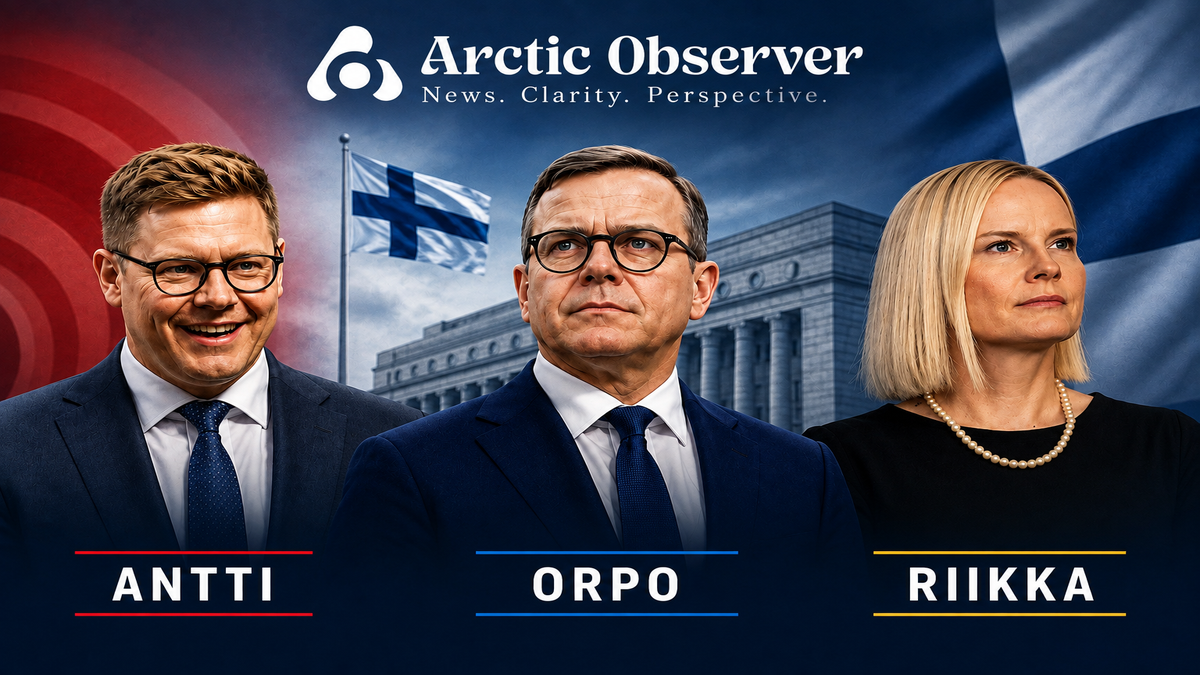
Antti is trying to reconnect Finland with its social values, Orpo is trying to rebuild a strained economy, Riikka is pushing nationalism further; Finland stands at a crossroads.
Finland is heading into what may well be its most consequential parliamentary election of the 21st century.
This is not merely another contest over taxation, healthcare or coalition arithmetic. It is a referendum on the country's identity at a time when Europe is confronting geopolitical instability, economic uncertainty and a fierce debate over migration. The government that emerges will not simply determine who occupies the Prime Minister's Office; it will decide what kind of Finland enters the next decade.
Three political narratives dominate the campaign, each reflecting a different diagnosis of the country's challenges.
For Social Democratic leader Antti Lindtman, Finland's greatest deficit is not fiscal but social. His campaign argues that years of spending cuts, labour market reforms and growing inequality have weakened the trust that has long underpinned the Nordic welfare model. In his view, restoring confidence in public institutions, strengthening welfare services and reducing inequality are not obstacles to economic growth—they are prerequisites for it.
Prime Minister Petteri Orpo offers a fundamentally different prescription. His government has argued that Finland can no longer finance its welfare state without painful structural reforms. Faced with weak economic growth, an ageing population and rising public debt, Orpo believes fiscal discipline and improved competitiveness are unavoidable. His supporters see him as a realist confronting difficult economic facts. His critics argue that his reforms risk weakening the very social cohesion that has historically made Finland economically resilient.
Then comes Riikka Purra and the Finns Party, whose message speaks less about economics than identity. While questions of national culture and immigration have long existed in Finnish politics, they have moved from the political margins to the centre of national debate. The Finns Party argues that immigration should be substantially reduced, asylum rules tightened and national sovereignty given greater weight in decision-making. Their rise reflects broader political currents visible across Europe, where concerns over migration increasingly intersect with debates about security, cultural identity and public trust.
The result is an election in which each major political force is speaking to a different national anxiety: one about social fragmentation, another about economic sustainability, and a third about national identity.
Finland needs economic renewal but remains deeply attached to its social model. It requires international workers while debating stricter immigration. It seeks greater influence within NATO and the European Union while simultaneously witnessing stronger calls for national sovereignty.
These are not contradictions that can be resolved through campaign slogans. They require difficult political choices whose consequences will extend far beyond a single parliamentary term.
Ultimately, this election is about more than choosing between parties or personalities. It is about determining which challenge Finland considers most urgent—and which future its citizens are prepared to embrace.
The next government will inherit a nation that remains among the world's most stable democracies. Whether it can preserve that stability while adapting to a rapidly changing Europe may become the defining political test of modern Finland.